Computational Neuroscience  ·  Columbia University

Valeria
Fascianelli

Ph.D.  ·  Associate Research Scientist

Associate Research Scientist in Computational Neuroscience
Zuckerman Institute, Columbia University, New York

Valeria Fascianelli

About

About Me

How do billions of interconnected units — biological or artificial — give rise to something rich as behavior? This question is what drew me from physics into neuroscience.

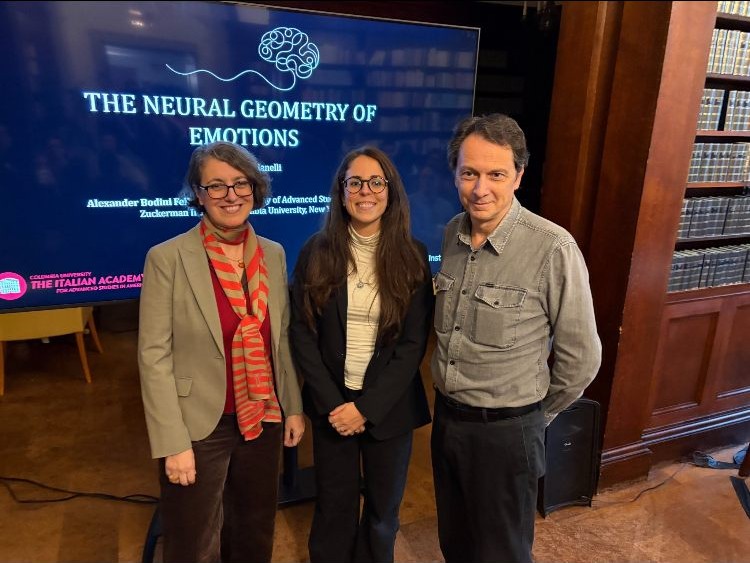
I am a physicist by training and now an Associate Research Scientist in computational neuroscience at Columbia University, New York. I was awarded the Alexander Bodini Fellowship at the Italian Academy for Advanced Studies at Columbia University. I work closely with experimentalists and I am interested in understanding not only whether the brain encodes information, but how it is formatted, because the same information, represented in different ways, can change a network's computational properties, thereby biasing subsequent behaviors.

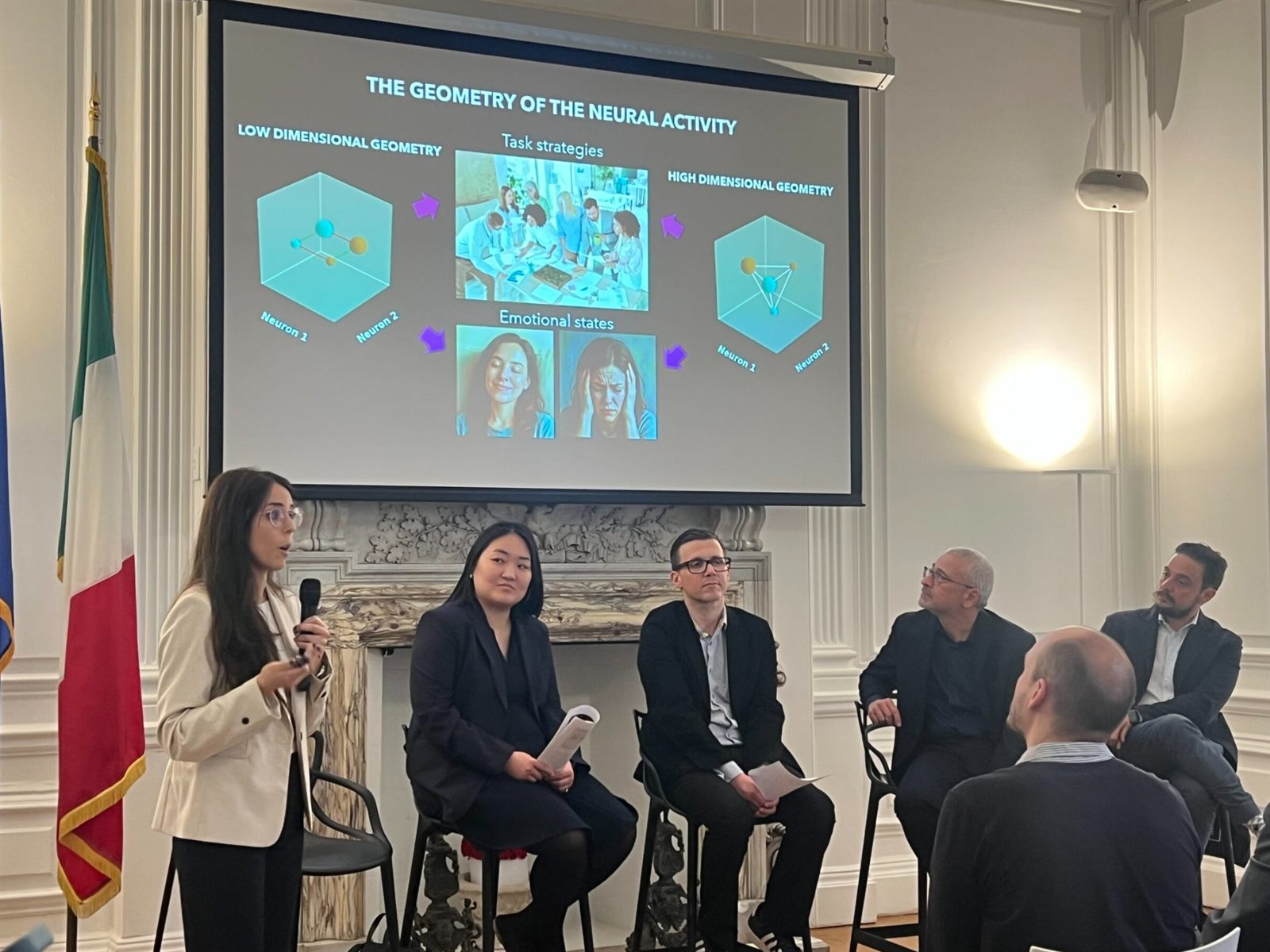
I used the representational-geometry framework to uncover individual cognitive strategies to solve the same laboratory task, to probe decision-making in cerebellar Purkinje cells, to understand cognitive processes distributed across multi-regional circuits, and to characterize the internal states that follow stress in the amygdala and hippocampus. I build interpretable, data-driven models — combining machine learning, reinforcement learning, and dynamical-systems modeling — to understand how the geometry of neural activity shapes behavior, and increasingly to use that same geometry as an interpretability tool for large-scale AI models.

During my Ph.D. in neuroscience I studied how intrinsic neural timescales differ across cortical areas and the basal ganglia, revealing how slow and fast dynamics support distinct computations. And before turning to computational neuroscience, I worked at CERN on the NA62 experiment, where I worked with big data, learning to find structure in massive, complex datasets.

Current Position

Associate Research Scientist Center for Theoretical Neuroscience
Zuckerman Institute, Columbia University
New York, USA  ·  2025–present

Previous Positions

Bodini Fellow Italian Academy for Advanced Studies, Columbia University
New York, USA  ·  2025
Postdoctoral Research Scientist Center for Theoretical Neuroscience
Zuckerman Institute, Columbia University
New York, USA  ·  2020–2025

Education

  • Ph.D. in Neuroscience La Sapienza University, Rome  ·  2020
  • M.Res. in Particle Physics University of Birmingham, UK  ·  2016
  • M.Sc. in Nuclear & Subnuclear Physics University Tor Vergata, Rome  ·  2014
  • B.Sc. in Physics University Tor Vergata, Rome  ·  2011

Research

Research Interests

01 Representational geometry as an AI interpretability tool
02 Multi-brain region models and neural decoding
03 Reinforcement learning shaping representational geometry
04 How affective states shape network geometry and behavior

Highlighted Research

Selected Works

Nature Communications · 2024 Read article ↗
17k Accesses
60 Citations
41 Altmetric

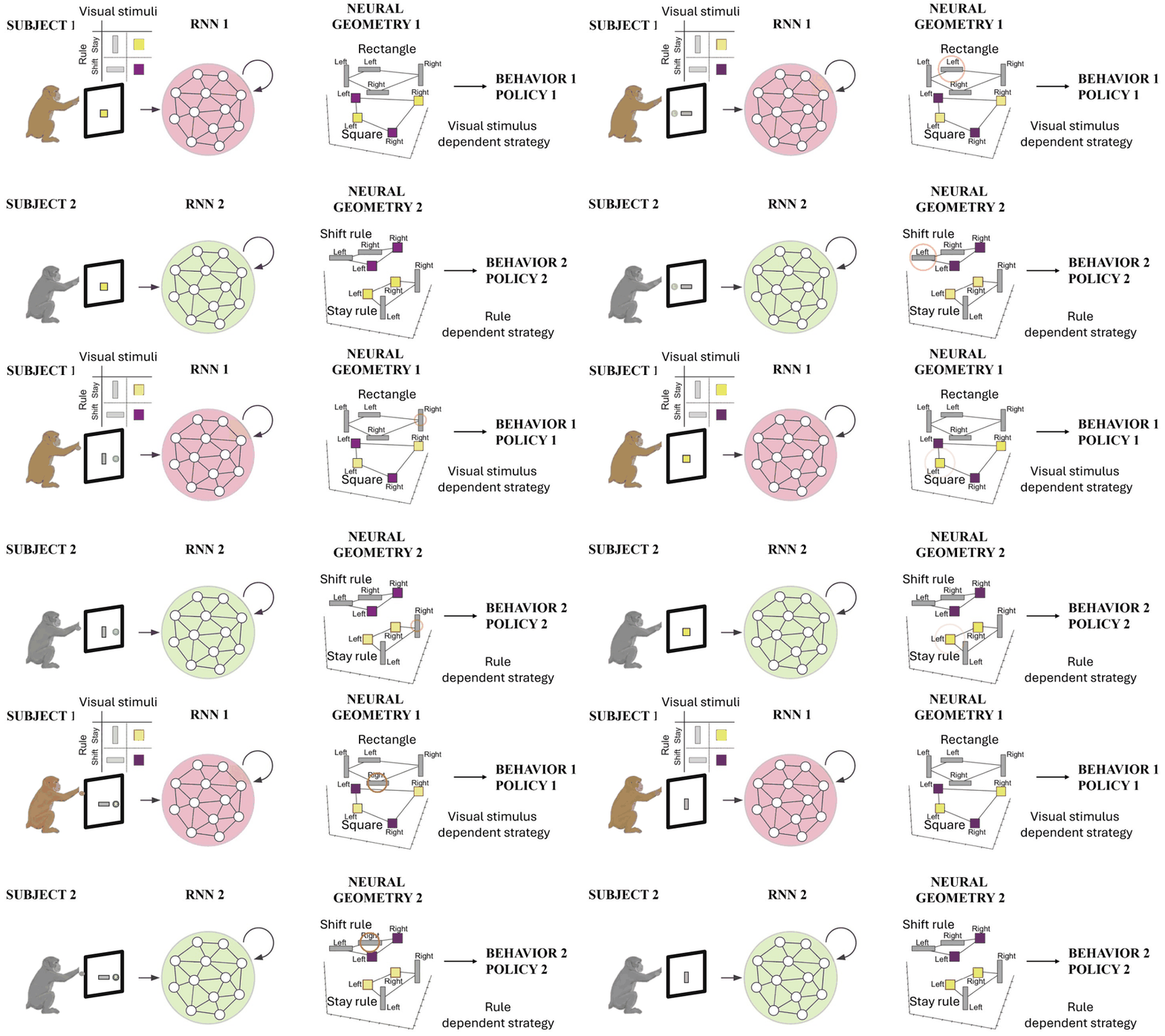
Neural representational geometries reflect behavioral differences in monkeys and recurrent neural networks

V. Fascianelli et al. (Nature Communications, 2024)

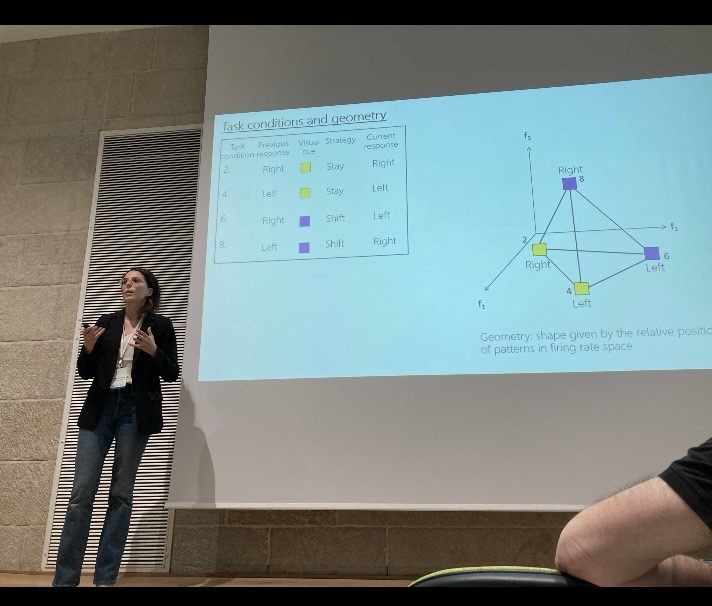
Animals likely use a variety of strategies to solve laboratory tasks. Here, we showed that the differences in neural geometry are associated with differences in the reaction times, suggesting that the monkeys are using different strategies. Using recurrent neural network models trained to perform the same task, we show that these strategies correlate with the amount of training.
Task animation — neural geometry and behavioral strategies
Task animation: neural geometry and behavioral strategies
Nature · 2025 Read article ↗
71k Accesses
42 Citations
316 Altmetric

Understanding the neural code of stress to control anhedonia

F. Xia*, V. Fascianelli* et al. (Nature, 2025)  ·  * Equal contribution

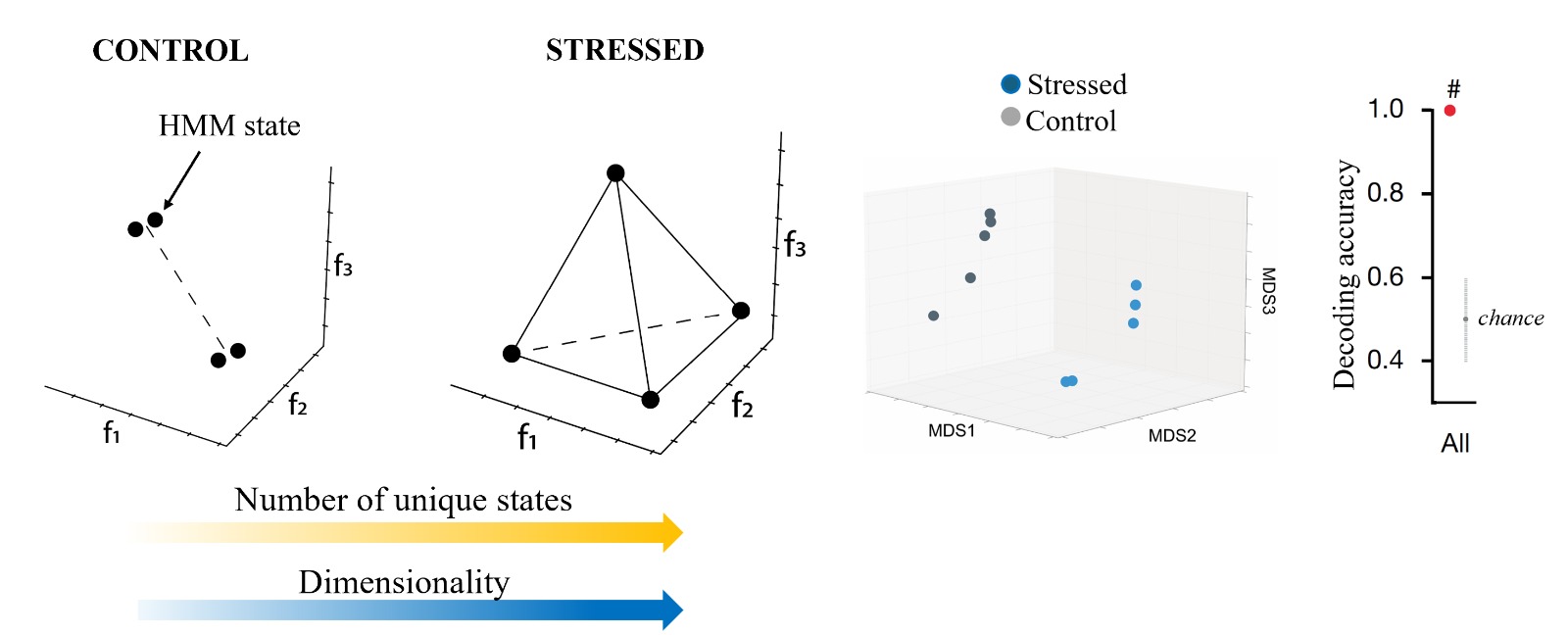
How to assess the representational geometry of resting activity to characterize emotional states? Here, we showed that the spatial arrangement of internal states of amygdala activity at rest allowed us to infer whether a mouse had a history of stress better than behavioral outcomes alone. This work reveals population-level neural dynamics that explain individual differences in responses to traumatic stress.
HMM states and representational geometry of amygdala activity under stress — MDS and decoding accuracy
Neural geometry of amygdala HMM states: stressed vs. control mice (MDS) and decoding accuracy

CV

Experience

Download CV

Grants & Fellowships

2026 National Scientific Qualification as Associate Professor in Applied Physics, Italy
2025 Research Fellowship, Italian Academy for Advanced Studies, New York
2018 Avvio alla Ricerca Grant, La Sapienza University
2018 Best Project Award, BCBT Summer School (IBEC, Barcelona)

Teaching & Mentorship

2025 Invited Lecturer, Mathematical Methods in Computational Neuroscience Summer School — Kavli Institute
2022–24 Lecturer, Advanced Neurotheory Course — Columbia University
2022–23 Teaching Assistant, Cognitive Science — Barnard College
2023 Teaching Assistant, Methods in Computational Neuroscience Summer School — MBL, Woods Hole
2022 Mentor, Leadership Alliance Summer Program — Center for Theoretical Neuroscience, Columbia University
2014–15 Teaching Assistant, Calculus — University of Birmingham

Talks & Conferences

2026 Invited Speaker, Microsoft, New York
2026 Invited Speaker, Paris Brain Institute (Neuro/AI), Paris
2026 Invited Speaker, Kavli Symposium, Columbia University, New York
2026 Invited Speaker, Center for Computational Neuroscience, Flatiron Institute, New York
2026 Invited Speaker, CUNY, New York
2026 Invited Speaker, Workshop "Renormalization Principles in Neural Systems", Cosyne, Lisbon
2026 Poster, "Neural Geometry Dynamics Reveal Computational Roles in Multiple Brain Regions During Decision Making", Cosyne, Lisbon
2025 Invited Speaker, Institute of Neuromodulation (Neurospin), Paris
2025 Invited Speaker, Paris Brain Institute, Paris
2025 Invited Speaker, Bocconi University, Milan
2025 Invited Speaker, Mount Sinai, New York
2025 Invited Speaker, Institute of Science and Technology Austria (ISTA), Vienna
2025 Invited Speaker, Italian Academy of Advanced Studies, Columbia University, New York
2025 Invited Speaker, IMT Advanced Studies, Lucca
2025 Research Visitor, Kavli Institute for Systems Neuroscience, Trondheim, Norway
2025 Co-Chair, Biocomputation Session, Mathematics of Neuroscience & AI, Split, Croatia
2025 Invited Speaker, Kavli Institute for Systems Neuroscience, Norway
2025 Invited Speaker, Workshop "Relational Inference and Knowledge Composition via Neuronal Geometric Representations", Bernstein Conference, Mainz, Germany
2025 Invited Speaker, Workshop "Neuro-inspired AI", La Sapienza, Rome
2025 Co-Chair, "Neural Data" Session, Mathematics for Neuroscience & AI, Split, Croatia
2025 Invited Speaker, Workshop "Brain Mechanisms of Working Memory: Where Do We Stand?", Cosyne, Montreal
2024 Poster, AREADNE, Milos, Greece
2024 Poster, Cosyne 2024, Lisbon
2023 Poster, Cosyne 2023, Montreal
2022 Poster, SfN 2022, San Diego
2022 Poster, Neuronex Meeting 2022, San Diego
2022 Invited Speaker, Swartz Meeting, Cold Spring Harbor Laboratory, Long Island
2022 Invited Speaker, Tri-Center Gatsby Meeting, Hebrew University, Jerusalem
2021 Poster, SfN 2021, Online
2018 Poster, Italian National Congress in Neuroscience, Ischia
2017 Poster, Italian National Meeting of PhD Students in Neuroscience, Naples
Publications

CV & Publications

Download full CV (PDF)  ·  View on Google Scholar

Neuroscience

  • 2026 In prep.

    V. Fascianelli*, J. Munuera*, B. Wang, S. Bernardi, C. D. Salzman, S. Fusi. Neural Geometry Dynamics Reveal Computational Roles In Multiple Brain Regions During Decision Making. * Co-first authorship

  • 2026 Under review

    L. Vignozzi, S. Varani, A. Leparulo, V. Fascianelli, E. Beretta, S. Vassanelli, G. Deidda, M. Allegra. Intra-hemispheric functional signatures predict motor recovery after stroke. iScience.

  • 2026 Accepted for
    publication

    A. E. Ipata*, V. Fascianelli*, C. I. De Zeeuw, N. Sendhilnathan, S. Fusi, M. E. Goldberg. Purkinje cells in Crus I and II encode the visual stimulus and the impending choice as monkeys learn a reinforcement based visuomotor association task. Journal of Neuroscience. * Co-first authorship

  • 2025 Nature

    F. Xia*, V. Fascianelli*, N. Vishwakarma, F. G. Ghinger, A. O. Kwon, M. M. Gergues, L. K. Lalani, S. Fusi, M. A. Kheirbek. Understanding the neural code of stress to control anhedonia. Nature (2025). * Co-first authorship

    nature.com →
  • 2024 Nat. Commun.

    V. Fascianelli, A. Battista, F. Stefanini, S. Tsujimoto, A. Genovesio, S. Fusi. Neural representational geometries reflect behavioral differences in monkeys and recurrent neural networks. Nature Communications (2024).

    nature.com →
  • 2024 bioRxiv

    A. E. Ipata*, V. Fascianelli*, C. I. De Zeeuw, N. Sendhilnathan, S. Fusi, M. E. Goldberg. Purkinje cells in Crus I and II encode the visual stimulus and the impending choice as monkeys learn a reinforcement-based visuomotor association task. bioRxiv (2024). * Co-first authorship

    biorxiv.org →
  • 2024 PLoS Biology

    S. Nougaret, L. Ferrucci, F. Ceccarelli, S. Sacchetti, D. Benozzo, V. Fascianelli, R. C. Saunders, L. Renaud, A. Genovesio. Neurons in the monkey frontopolar cortex encode learning stage and goal during a fast learning task. PLoS Biology (2024).

    plos.org →
  • 2022 Prog. Neurobiol.

    L. Ferrucci, S. Nougaret, F. Ceccarelli, S. Sacchetti, V. Fascianelli, D. Benozzo, A. Genovesio. Social monitoring of actions in the macaque frontopolar cortex. Progress in Neurobiology (2022).

    sciencedirect.com →
  • 2021 Sci. Reports

    S. Nougaret, V. Fascianelli, S. Ravel, A. Genovesio. Intrinsic timescales across the basal ganglia. Scientific Reports (2021).

    nature.com →
  • 2020 J. Neurosci.

    V. Fascianelli, L. Ferrucci, S. Tsujimoto, A. Genovesio. Neural correlates of strategy switching in the macaque orbital prefrontal cortex. Journal of Neuroscience (2020).

    jNeuroscience →
  • 2019 Cereb. Cortex

    V. Fascianelli, E. Marcos, S. Tsujimoto, A. Genovesio. Autocorrelation structure in the macaque dorsolateral, but not orbital or polar, prefrontal cortex predicts response-coding strength in a visually cued strategy task. Cerebral Cortex (2019).

    oup.com →
  • 2018 iScience

    R. Cirillo*, V. Fascianelli*, L. Ferrucci, A. Genovesio. Neural intrinsic timescales in the macaque dorsal premotor cortex predict the strength of spatial response coding. iScience (2018). * Co-first authorship

    iScience →

Physics  ·  NA62 Collaboration at CERN

Selected publications from the NA62 experiment at CERN — searches for rare K+ decays, heavy neutral leptons, dark photons, and lepton number violation.

  • 2024 Phys. Lett. B

    E. C. Gil et al. Measurement of the K+ → π+γγ decay. Physics Letters B (2024).

    sciencedirect.com →
  • 2023 JHEP

    E. C. Gil et al. Performance of the NA62 trigger system. Journal of High Energy Physics (2023).

  • 2023 Phys. Lett. B

    E. C. Gil et al. A search for the K+ → µνe+e+ decay. Physics Letters B (2023).

  • 2022 JHEP

    E. C. Gil et al. A measurement of the K+ → π+µ+µ decay. Journal of High Energy Physics (2022).

  • 2022 Phys. Lett. B

    E. C. Gil et al. Searches for lepton number violating K+ → ππ0e+e+ decays. Physics Letters B (2022).

  • 2022 NIM-A

    A. Akmete et al. High level performance of the NA62 RICH detector. Nuclear Instruments and Methods in Physics Research A (2022).

  • 2021 PRL

    R. Aliberti et al. Search for Lepton Number and Flavor Violation in K+ and π0 Decays. Physical Review Letters (2021).

  • 2021 JHEP

    E. C. Gil et al. Measurement of the very rare K+ → π+νν̄ decay. Journal of High Energy Physics (2021).

  • 2021 JHEP

    E. C. Gil et al. Search for a feebly interacting particle X in the decay K+ → π+X. Journal of High Energy Physics (2021).

  • 2021 PRL

    F. Ambrosino et al. Search for Lepton Number and Flavor Violation in π0 Decays. Physical Review Letters (2021).

  • 2020 Phys. Lett. B

    E. C. Gil et al. Search for heavy neutral lepton production in K+ decays to positrons. Physics Letters B (2020).

  • 2020 JINST

    E. C. Gil et al. Final performances of the NA62 RICH detector. Journal of Instrumentation (2020).

  • 2019 JHEP

    E. C. Gil et al. Search for production of an invisible dark photon in π0 decays. Journal of High Energy Physics (2019).

  • 2019 Phys. Lett. B

    E. C. Gil et al. First search for K+ → π+νν̄ using the decay-in-flight technique. Physics Letters B (2019).

  • 2018 Int. J. Mod. Phys. A

    R. Aliberti et al. Search for heavy neutral leptons at the NA62 experiment at CERN. International Journal of Modern Physics A (2018).

  • 2017 JINST

    E. C. Gil et al. The Beam and detector of the NA62 experiment at CERN. Journal of Instrumentation (2017).

  • 2017 JINST

    G. A. Rinella et al. NA62 Charged Particle Hodoscope: design and performance in the 2016 run. Journal of Instrumentation (2017).

Contact

Get in touch

I'm always glad to hear about potential collaborations, new research ideas, or open positions — or simply to talk science.